Charging Cable Braiding Solutions

Consumer electronics cable braiding equipment combining protection and aesthetics

Charging cable braiding outer layers not only protect internal precision conductors from bending damage and electromagnetic interference, but also significantly enhance product texture and brand value. Fengyan Machinery provides full-series charging cable braiding solutions from USB-C to Lightning, from single-color minimalist to gradient dazzle, supporting nylon, PET, metallic yarn and other outer materials, meeting consumer electronics market demands for both quality and efficiency.
Applicable Materials

nylon 66 (200D-800D)

PET monofilament

tinned copper wire (shielding)

aluminum-magnesium alloy wire

polyester colored yarn

Braiding Process

1

Core Wire Feeding and Protection

Pre-made charging cable core (conductor, insulation, shielding) is fed into the braiding zone through a soft feeding tube. Tube inner diameter 1-2mm larger than core OD, material low-friction POM or PTFE. Core tension controlled at 0.5-1.2N, precisely adjusted by servo payoff stand.

2

Precision Braiding and Covering

Using 24-carrier braiding machine, carrier speed 280-350rpm, braiding coverage ≥85%. Charging cable OD typically 2-5mm, requiring small-diameter braiding heads (diameter ≤20mm) and precision guide wheels.

3

Heat Setting Treatment

After braiding, pass through heat setting machine (100-140°C) to make the braid layer closely adhere to the core, eliminating fluffiness. Post-setting braid layer has uniform thickness with no relative sliding against the core.

4

Surface Coating (Optional)

According to customer requirements, hand-feel finishing agent (silicone oil emulsion) or flame retardant coating can be added to the braid surface. After coating, pass through drying tunnel (80-100°C) for curing.

5

End Processing

Braided cable cut to order length, braid layer stripped at ends to expose connector areas, followed by injection molding or metal shell assembly. End braid stripping requires dedicated hot-cut knife to prevent fraying.

Recommended Equipment

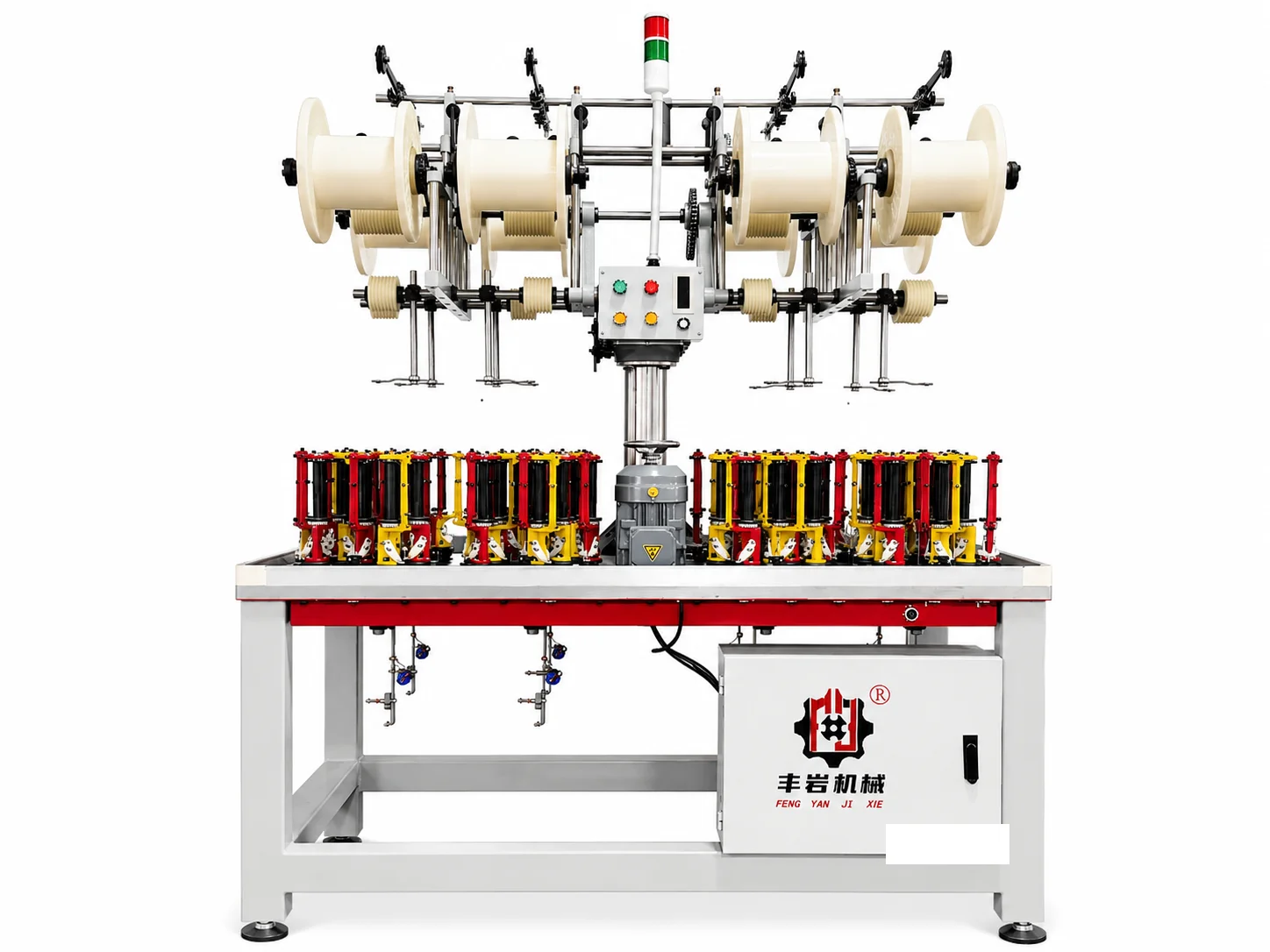
FY-24 High Speed Braiding Machine

Suitable for standard USB/Type-C charging cable braiding, balancing capacity and precision

Config: Recommended options: small-diameter braiding head, core tension buffering system, precision guide wheels

FY-32 High Speed Braiding Machine

Suitable for large-diameter (≥5mm) or high-density braided data cables

Config: Recommended options: auto cutting/stripping integration, metallic yarn dedicated carriers

Key Process Parameters

Applicable Cable Diameter2-8mm
Braiding Carriers24/32 carriers
Spindle Speed280-350 RPM
Braiding Coverage≥85%
Core Wire Tension0.5-1.2N
Braiding Pitch3-12mm
Theoretical Capacity100-300 m/hour
Setting Temperature100-140°C
Braiding Head Diameter≤20mm
Guide Wheel MaterialCeramic/Hard Alloy

Quality Control Standards

Braiding Coverage

≥85%, no light visible through

Cable Diameter Consistency

OD deviation ≤±5%

Braid Layer Adhesion

Axial sliding ≤2mm/10N pull

Bending Life

≥10000 cycles (radius 20mm)

Flame Retardancy

UL VW-1 or IEC 60332

Appearance Quality

No color difference, no contamination, no fraying

Frequently Asked Questions

What should the charging cable braiding coverage rate be?

General consumer-grade charging cables need ≥80% coverage for protection; mid-to-high-end product lines recommend ≥85% for tighter feel and better abrasion resistance; for data cables requiring EMI shielding, coverage needs ≥90% with tinned copper wire braiding. Coverage calculation formula: Coverage = (single yarn cross-section × yarn count × 2) / (π × braid inner diameter × sin(braiding angle)) × 100%.

What is the difference between metallic wire braiding and nylon braiding?

Metallic wire braiding (tinned copper, aluminum-magnesium alloy) mainly provides EMI shielding and mechanical reinforcement, with metallic luster appearance, harder hand feel, higher cost. Nylon braiding mainly provides abrasion protection and aesthetics, with soft hand feel, rich colors, lower cost. Some premium data cables use "nylon + metallic wire" composite braiding—outer nylon provides feel and color, inner metallic wire provides shielding.

How to improve the bending life of braided charging cables?

Key factors for improving bending life: 1) Braiding angle controlled at 35°-45°, too small makes line body stiff and prone to breaking; 2) Moderate tightness between braid layer and core, too loose causes sliding wear, too tight increases core stress; 3) Use high-toughness nylon 66 instead of ordinary polyester; 4) Add缓冲 layer (like foamed TPU) between braid and core; 5) Reinforced end design, strain relief (SR) length ≥15mm. With these measures, bending life can improve from 3,000 to over 10,000 cycles.

Get a Customized Solution

Our technical team will analyze your product requirements and recommend the most suitable equipment configuration and process parameters.

Submit Inquiry