PE Fishing Line Braiding Solutions
High-precision, high-strength, ultra-durable professional fishing line braiding equipment
PE (Ultra-High Molecular Weight Polyethylene) fishing line has become the mainstream choice in the high-end fishing tackle market due to its ultra-high strength, ultra-light weight, and excellent abrasion resistance. Fengyan Machinery provides full-series fishing line braiding solutions from 4-strand to 16-strand, equipped with precision servo tension control systems ensuring inter-yarn tension deviation within 5% and industry-leading braiding density uniformity.
Applicable Materials
PE raw yarn (200D-3000D)
Dyneema fiber
Spectra fiber
nylon coated yarn
fluorocarbon coated yarn
Braiding Process
Material Pretreatment
PE fiber undergoes preheating treatment before braiding, heating to 60-80°C for 15-20 minutes to reduce internal residual stress and improve braiding conformability. Preheating temperature accuracy must be maintained within ±2°C.
Multi-Carrier Cross Braiding
Using 16-24 carrier high-speed braiding machines, carrier speed 200-350rpm, braiding angle controlled between 30°-45°. Each PE fiber tension precisely controlled within 0.8-1.5N, with inter-carrier tension variation not exceeding 5%.
Heat Setting Treatment
After braiding, heat setting at 120-140°C for 30-60 seconds eliminates internal stress and stabilizes line structure. Post-heat-setting line shrinkage controlled within 1%.
Surface Coating
Coating material selected by application: freshwater fishing uses polyurethane coating for abrasion resistance, saltwater fishing uses fluorocarbon coating for salt spray corrosion resistance. Coating thickness 0.05-0.15mm, curing temperature 150-200°C.
Precision Winding
Constant-tension take-up system linked to braiding speed prevents loose inner layers and tight outer layers. Winding length accuracy ±0.5%, supports automatic length cutting and label printing.
Recommended Equipment
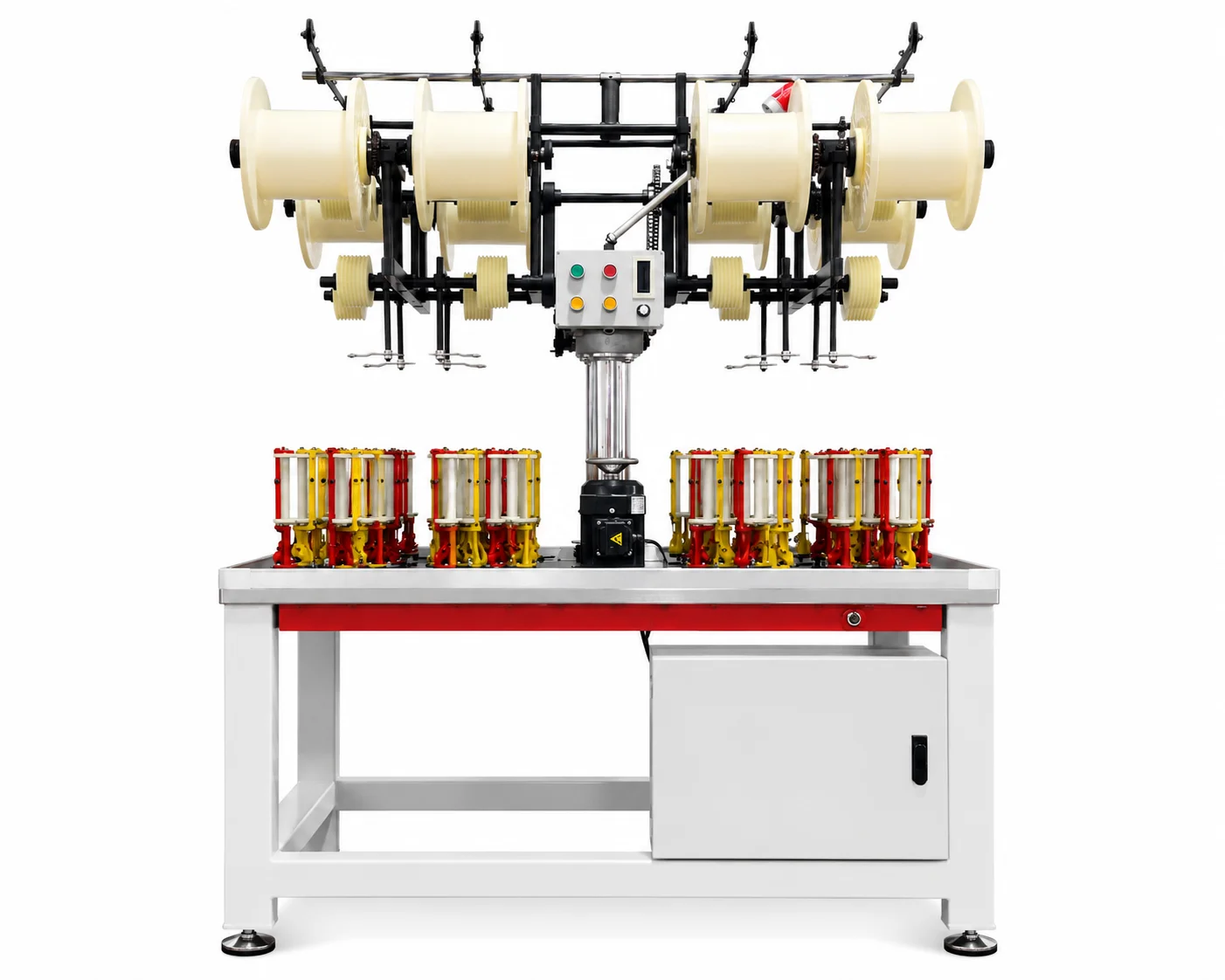
FY-16 High Speed Braiding Machine
Suitable for 4-strand/8-strand PE fishing line, high cost-performance, compact footprint
Config: Recommended options: servo spindle, precision tension control, pre-heating device
FY-24 High Speed Braiding Machine
Suitable for 12-strand/16-strand high-density PE fishing line, higher capacity
Config: Recommended options: double-layer carrier seat, auto yarn change, online tension monitoring
Key Process Parameters
| Applicable Line Diameter Range | 0.1-0.8mm |
| Braiding Carriers | 16/24 carriers |
| Spindle Speed | 200-350 RPM |
| Braiding Angle | 30°-45° |
| Per-Yarn Tension | 0.8-1.5N |
| Braiding Pitch | 8-25mm |
| Theoretical Capacity | 60-150 m/hour |
| Pre-heating Temperature | 60-80°C |
| Heat Setting Temperature | 120-140°C |
| Workshop Temperature/Humidity | 20-25°C / 50-60%RH |
Quality Control Standards
Line Diameter Uniformity
Diameter deviation ≤±3%
Braiding Density
Coverage ≥85%, deviation ≤±2%
Knot Strength
≥60% of line breaking strength
Abrasion Resistance
Taber abrasion 1000 revolutions mass loss ≤3%
Tensile Strength
≥95% of nominal value
Color Fastness
GB/T 3921-2008 ≥Grade 4
Frequently Asked Questions
What is the difference between PE fishing line braiding machines and general braiding machines?
PE fishing line braiding machines require higher tension control precision (±0.1N), more precise spindle speed control (±0.01%), and dedicated pre-heating devices. Additionally, ceramic guide wheels are needed to reduce PE fiber wear, and constant-tension take-up systems ensure consistent tension between inner and outer layers of the spool.
Which model should I choose for 4-strand vs 8-strand fishing line?
4-strand line has a relatively simple structure, satisfied by 16-carrier models; 8-strand requires more carriers, recommend 24-carrier models. If your product line includes both 4-strand and 8-strand, choose a 24-carrier model directly, adjusting the number of active carriers for different products.
What is the typical scrap rate for PE fishing line braiding?
With high-precision servo models, scrap rate can be controlled below 1%; ordinary VFD models have about 2-3% scrap rate. Main scrap causes include density deviation from uneven tension, broken thread joints, and line deformation from improper heat setting temperature.
Get a Customized Solution
Our technical team will analyze your product requirements and recommend the most suitable equipment configuration and process parameters.
Submit Inquiry