Fiberglass Sleeving Braiding Solutions

Professional braiding equipment for motor insulation, wiring harness protection, and high-temperature sealing

Fiberglass sleeving is widely used in motor insulation, wiring harness protection, and high-temperature environment sealing. Its braiding process has special requirements for equipment precision, tension control, and post-processing. Fengyan Machinery provides full-series fiberglass sleeving braiding solutions covering Class A to Class C insulation grades, meeting high-end applications from household appliances to aerospace.
Applicable Materials

E-glass alkali-free fiberglass (300-1200tex)

C-glass medium-alkali fiberglass

silane coupling agent sizing

polyurethane coating

silicone coating

PTFE coating

Braiding Process

1

Sizing Treatment

Glass fiber yarn must undergo sizing treatment (silane coupling agent or paraffin emulsion, 1.5-3.0% solids), increasing friction coefficient to 0.35-0.45, improving bundle cohesion and abrasion resistance. Drying temperature 80-100°C, time 15-20 minutes.

2

Precision Braiding

Using 24-32 carrier braiding machines, carrier speed controlled at 120-180rpm. Braiding angle 38°-42°, per-yarn tension 0.3-0.8N, inter-carrier variation ≤3%. For heavy-duty sleeving with wall thickness ≥1.5mm, use double-layer braiding process.

3

Heat Setting Treatment

Braided sleeving passes through a high-temperature oven (380-420°C, 30-60 seconds), allowing glass fiber molecular structure to rearrange, eliminating braiding internal stress and stabilizing dimensions. Post heat-setting shrinkage controlled within 1%.

4

Surface Coating and Curing

Coating selected by insulation class: Class F (155°C) polyurethane, Class H (180°C) silicone, Class C (>220°C) PTFE. Coating thickness 0.05-0.15mm, curing temperature 150-200°C, time 20-40 minutes.

5

Quality Inspection

Pass voltage withstand test (2kV/1min no breakdown), insulation resistance test (≥10¹² Ω·cm), tensile strength test (≥200N/10mm), abrasion resistance test, and flame retardancy test (UL VW-1).

Recommended Equipment

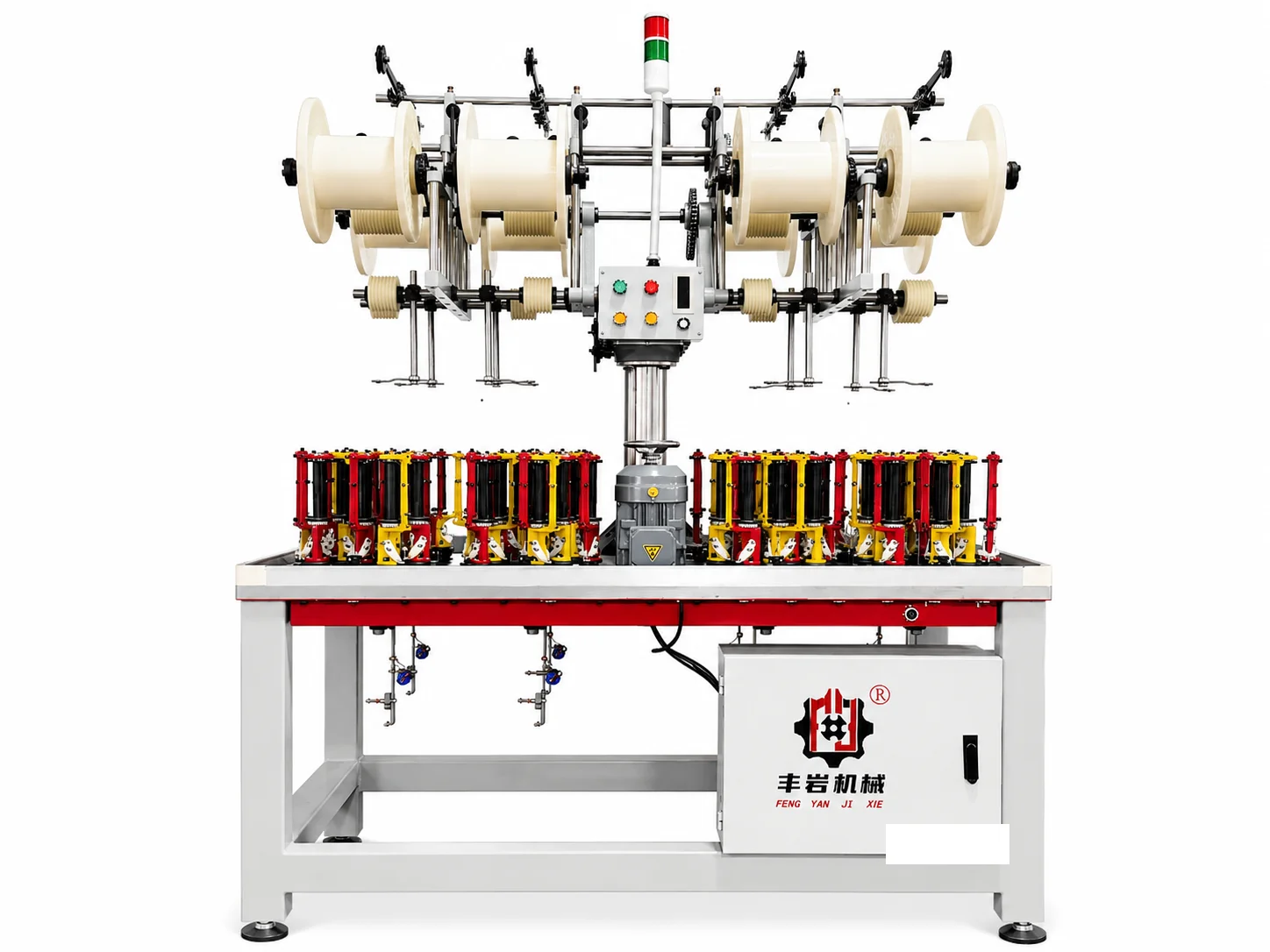
FY-24 High Speed Braiding Machine

Suitable for medium-diameter (6-16mm) standard insulation sleeving braiding

Config: Recommended options: low-tension control system, ceramic yarn guides, anti-static device

FY-32 High Speed Braiding Machine

Suitable for large-diameter (10-25mm) and double-layer braided sleeving

Config: Recommended options: double-layer carrier seat, precision pitch control, online wall thickness monitoring

Key Process Parameters

Applicable Sleeving Diameter2-25mm
Braiding Carriers24/32 carriers
Spindle Speed120-180 RPM
Braiding Angle38°-42°
Per-Yarn Tension0.3-0.8N
Braiding Pitch15-60mm
Heat Setting Temperature380-420°C
Coating Curing Temperature150-200°C
Insulation ClassClass A/F/H/C
Voltage Withstand Class1-35kV

Quality Control Standards

Voltage Withstand Test

IEC 60684: 2kV/1min no breakdown

Insulation Resistance

Normal ≥10¹² Ω·cm, after damp heat ≥10¹⁰ Ω·cm

Tensile Strength

Axial ≥200N/10mm width

Abrasion Resistance

Taber abrasion 1000 revolutions mass loss ≤5%

Flame Retardancy

UL VW-1 vertical burning standard

Thermal Aging

After 180°C/168h, tensile strength retention ≥80%

Frequently Asked Questions

Why does fiberglass sleeving braiding require low speed?

Glass fiber is brittle and breaks easily when bending radius is less than 3mm. Excessive carrier speed causes yarn tension fluctuations from increased centrifugal force, raising breakage risk. Additionally, glass fiber has low surface friction coefficient (0.15-0.25), and high-speed operation generates flyings that accelerate guide wheel wear and pollute the workshop.

What are the differences between coatings for different insulation classes?

Class F (155°C) uses polyurethane coating, lower cost, suitable for general motor insulation; Class H (180°C) uses silicone coating with better high-temperature performance and flexibility, suitable for high-temperature motors and transformers; Class C (>220°C) uses PTFE coating with best chemical corrosion resistance and non-stick properties, suitable for aerospace and nuclear power extreme environments.

How are inner and outer layer parameters configured for double-layer braided sleeving?

Inner layer uses finer count yarn (300-450tex) at smaller angle (35°-38°) for softness and conformability; outer layer uses coarser count yarn (600-900tex) at larger angle (42°-45°) for abrasion resistance and crush strength. Opposite braiding directions significantly improve anti-twist performance.

Get a Customized Solution

Our technical team will analyze your product requirements and recommend the most suitable equipment configuration and process parameters.

Submit Inquiry