Elastic Band Braiding Solutions

Professional elastic band braiding equipment with lasting elasticity and high recovery rate

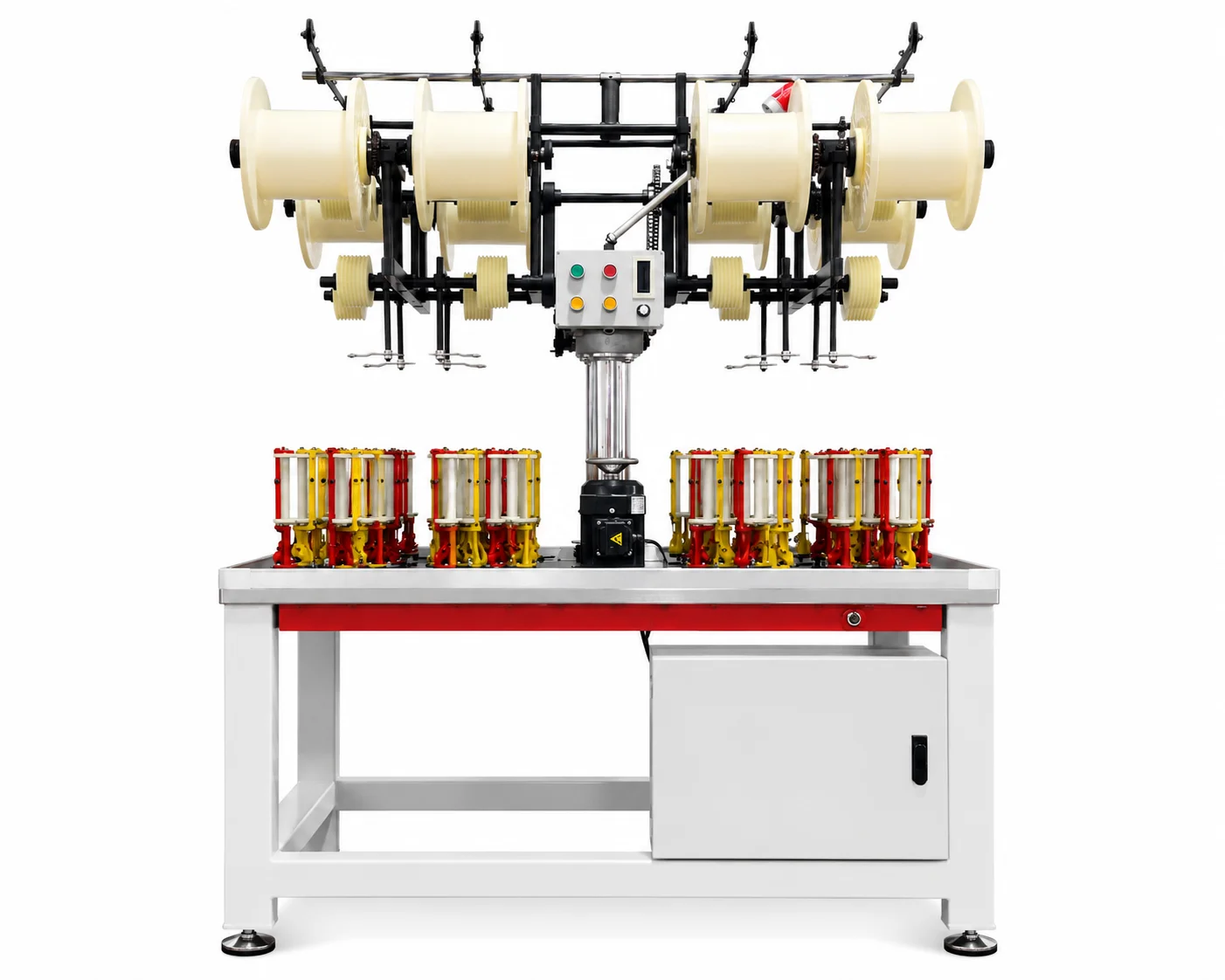
Elastic bands are widely used in clothing, medical, sports equipment and other fields. The core challenge in their braiding process lies in the high elongation and recovery characteristics of elastic yarns (spandex, rubber thread). Fengyan Machinery provides full-series braiding solutions from ordinary clothing elastic bands to medical high-elastic bandages, with elastic recovery rates above 90%, meeting strict requirements for elasticity and durability across industries.
Applicable Materials

spandex yarn (20D-140D)

rubber thread (#30-#90)

nylon covered yarn

polyester covered yarn

cotton yarn

latex thread

Braiding Process

1

Elastic Yarn Pretreatment

Spandex yarn needs pre-stretching to 120-150% of original length; rubber thread needs surface finish inspection (no sticking, no bubbles). All elastic materials should be stored at 20-25°C for over 24 hours to reach stable condition.

2

Covering and Braiding

Using covering spindles with spandex/rubber thread as core yarn, outer layer covered with protective nylon or polyester yarn (covering ratio 1:2 to 1:3). Covered yarn then enters braiding process using 16-24 carrier braiding machines at 200-280rpm.

3

Dynamic Tension Compensation

Elastic yarn continuously retracts during braiding, requiring spring or pneumatic tensioners for dynamic compensation. Tension range 0.8-2.0N, adjusted in real time based on retraction rate.

4

Heat Setting Treatment

Hot setting machine (80-120°C) fixes braiding structure and eliminates internal stress. Post-setting elastic band maintains stable width and thickness in natural state.

5

Winding and Packaging

Take-up system equipped with tension gradient function, outer layer 10-15% lower tension than inner layer. Cut to order length (typically 25m/roll or 50m/roll), avoid excessive compression during packaging.

Recommended Equipment

FY-16 High Speed Braiding Machine

Suitable for standard clothing elastic bands, compact footprint, flexible changeover

Config: Recommended options: elastic yarn dedicated carrier groups, spring tensioners

FY-24 High Speed Braiding Machine

Suitable for wide elastic bands (≥20mm) and medical high-elastic bandages

Config: Recommended options: pneumatic tension compensation system, wide flat pressing device

Key Process Parameters

Applicable Band Width5-50mm
Braiding Carriers16/24 carriers
Spindle Speed200-280 RPM
Braiding Angle40°-55°
Elastic Yarn Tension0.8-2.0N
Pre-stretch Ratio120-150%
Covering Ratio1:2 to 1:3
Theoretical Capacity80-200 m/hour
Setting Temperature80-120°C
Elastic Recovery Rate≥90%

Quality Control Standards

Band Width Consistency

Width deviation ≤±3%

Elastic Recovery Rate

Recovery ≥90% after 100% stretch for 1 min

Tensile Strength

≥85% of nominal value

Fatigue Resistance

Recovery ≥80% after 5000 stretch cycles

Color Fastness

GB/T 3921 ≥Grade 4

Wash Durability

Elasticity retention ≥85% after 50 washes

Frequently Asked Questions

Why does elastic band braiding require pre-stretching?

Pre-stretching is a key process in elastic band braiding. Elastic yarn in relaxed state has larger diameter and uneven surface, direct braiding causes uneven covering and loose structure. After pre-stretching to 120-150%, yarn becomes thinner with uniform surface tension, covering effect improves, and post-braiding retraction forms stable elastic structure. Insufficient pre-stretching significantly reduces elastic recovery rate; excessive pre-stretching may cause yarn breakage.

Which is better for elastic band braiding, spandex or rubber thread?

Each has advantages; selection depends on application needs: Spandex (polyurethane fiber) has higher elastic recovery (≥95%), good chemical corrosion resistance, dyeable, suitable for high-end clothing and medical products, but higher price; Rubber thread (natural or synthetic latex) has lower cost, higher elastic modulus (tighter and bouncier), suitable for ordinary clothing and packaging, but poor aging resistance (UV and ozone cause hardening and breakage), and some people are allergic to latex. Medical products typically require spandex; for cost-sensitive disposable products, rubber thread is more economical.

Does elastic band elasticity degrade over time?

Yes, but degradation speed depends on material, process, and usage environment. Under normal conditions, spandex elastic band elasticity degrades about 5-10% in 1 year, 15-20% in 3 years; rubber thread degrades faster, possibly 15-25% in 1 year. Methods to slow degradation: 1) Use high-quality spandex (e.g., Invista LYCRA®); 2) Control heat setting temperature below 120°C; 3) Add heat stabilizers; 4) Avoid excessive stretching and high-temperature storage in packaging. Our equipment, through precise tension control and optimized heat setting processes, can control elastic degradation at the industry's lowest level.

Get a Customized Solution

Our technical team will analyze your product requirements and recommend the most suitable equipment configuration and process parameters.

Submit Inquiry